The best Gamma alternatives, grouped by what you need instead
The best Gamma alternative depends on why you are leaving. For a native PowerPoint file, use an add-in inside PowerPoint: Copilot, Claude for PowerPoint, or Plus AI. For design guardrails on a team, Beautiful.ai. For collaboration, Pitch. If you already design in Canva, stay there. If code or an AI agent makes the decks, heydecks.
I build heydecks, one of the tools here, so read with that in mind. Gamma itself is strong: if you are one person who wants a polished deck in a browser, you may not need an alternative. People leave for specific reasons, so I grouped the options by reason rather than ranking them one to ten.
#Why do people look for a Gamma alternative?
Four frictions come up again and again:
- Credits. The free plan gives 400 one-time credits that never refill, and a "Made with Gamma" badge on PDF and PPTX exports. Paid plans start at roughly $10 a month.
- PowerPoint export. Gamma's native unit is a vertical web card, so the .pptx is a conversion. Fonts and tables come through well now, but tall or interactive cards can need rework. I covered the details and fixes in Gamma's PowerPoint export.
- Brand control. Themes are not the same as a locked brand when non-designers ship decks.
- No person in the editor. Teams want software or an AI agent to produce the deck. Gamma now has a generate API (Pro and above) and an MCP server, but its center of gravity is still the browser.
#The best Gamma alternatives compared
| Tool | Best for | Where it runs | PowerPoint output | Starting paid price |
|---|---|---|---|---|
| Microsoft Copilot | Microsoft 365 users | Inside PowerPoint | Native file | Microsoft 365 Personal, $9.99/mo |
| Claude for PowerPoint | Working in a corporate template | PowerPoint add-in | Native file | Claude Pro, $20/mo |
| Plus AI | PowerPoint and Google Slides users | Add-in for both | Native file | $10/mo (annual) |
| Gemini in Google Slides | Google Workspace teams | Google Slides | Download as .pptx | Google AI Pro or Workspace Business Standard |
| Beautiful.ai | On-brand team slides | Web app plus PowerPoint add-in | Export on paid plans | $14.50/mo (annual) |
| Pitch | Collaborative team decks | Web app | Export from Plus plan | €10/mo (annual) |
| Canva | Teams already in Canva | Web design suite | Export, free plan included | Canva Pro (varies by region) |
| Presentations.ai | Sales, investor, board decks | Web app | Export | $20/mo (annual) |
| Decktopus | Guided first drafts | Web app | Export, may need cleanup | $9.99/mo (annual) |
| heydecks | Apps and AI agents generating decks | REST API and MCP server | Native, generated as slides (Solo and up) | Solo, $19/mo |
Prices are from each vendor's site in September 2026 and change often.
#If you need a real PowerPoint file: in-app AI
If your deck always ends up in PowerPoint, the cleanest alternative to Gamma is not another web generator. It is AI that works inside PowerPoint, because the output never needs converting.
Microsoft Copilot is built into PowerPoint for Microsoft 365 Personal, Family, and Premium subscribers and for Copilot business licenses. It drafts decks from a prompt or a Word document and edits the slides you have open. Claude for PowerPoint, generally available since May 2026 on Claude Pro and up, reads your slide master and builds slides in your template, including native charts. I compared these and the ChatGPT add-in in the best AI for PowerPoint.
#Plus AI
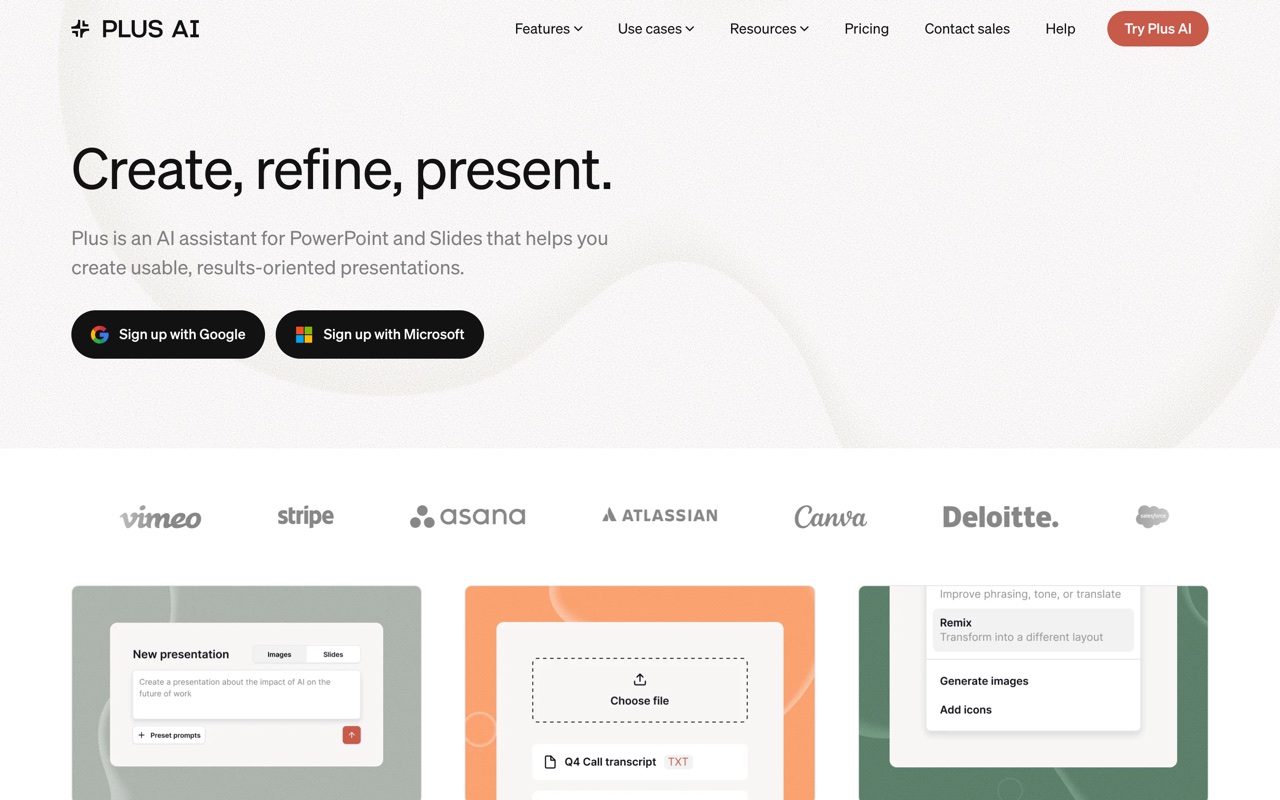 Plus AI runs as an add-in inside Google Slides and PowerPoint.
Plus AI is the Gamma alternative for people who refuse to leave Google Slides or PowerPoint. It generates and remixes slides in the host app, so there is no export step. Plans start at $10 per user a month billed annually, with custom branding on the $30 Team plan and a 7-day trial. The trade is that you get the host app's design ceiling, not a canvas with its own opinions. More on that in the Plus AI alternative comparison.
#If you want better design control for a team
#Beautiful.ai
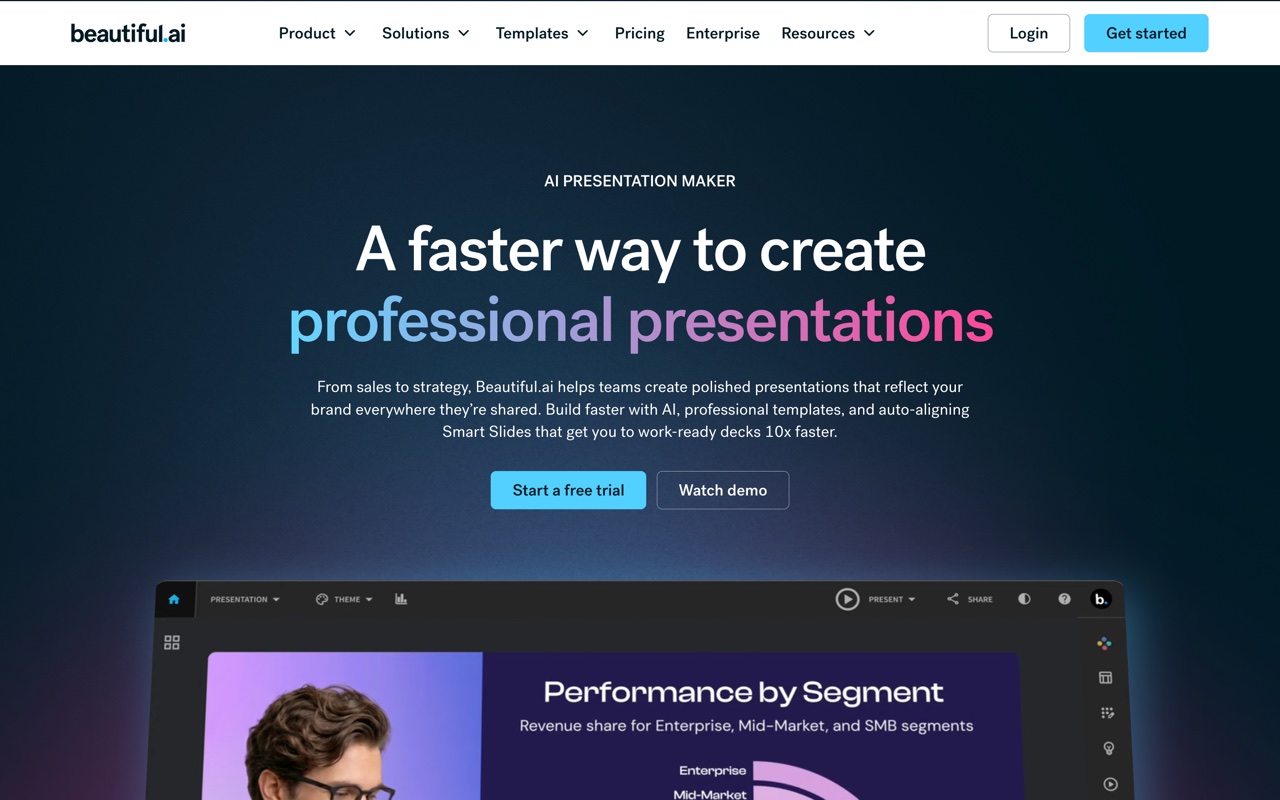 Beautiful.ai's smart templates re-balance the layout as you add content.
Beautiful.ai suits teams that want every slide tidy without a designer policing it: its smart slides adjust spacing and alignment as you edit. There is no free plan, only a 14-day trial with a card; Pro is $14.50 a month billed annually, and Team $40 per user. PowerPoint import and export are included, and there is a PowerPoint add-in. The same guardrails make off-template design harder. See the Beautiful.ai alternative page for where it fits.
#Presentations.ai
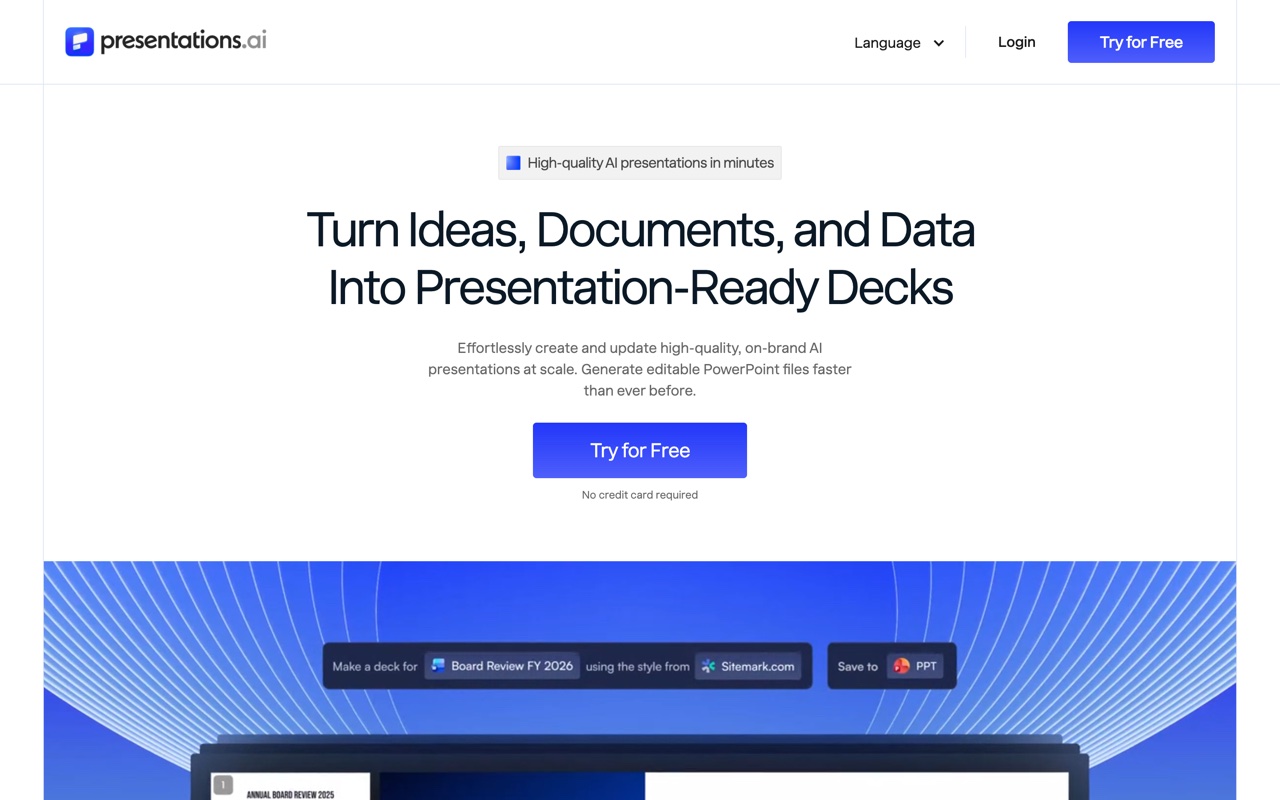 Presentations.ai targets sales, investor, and board decks.
Presentations.ai is the closest answer to "best alternative to Gamma for investor and sales decks." Its templates are tuned for business material and it adds team brand controls on the $50 Gold plan. The free Starter plan gives 100 credits a year and caps decks at 20 slides; Pro is $20 a month billed annually.
#If you build decks together
#Pitch
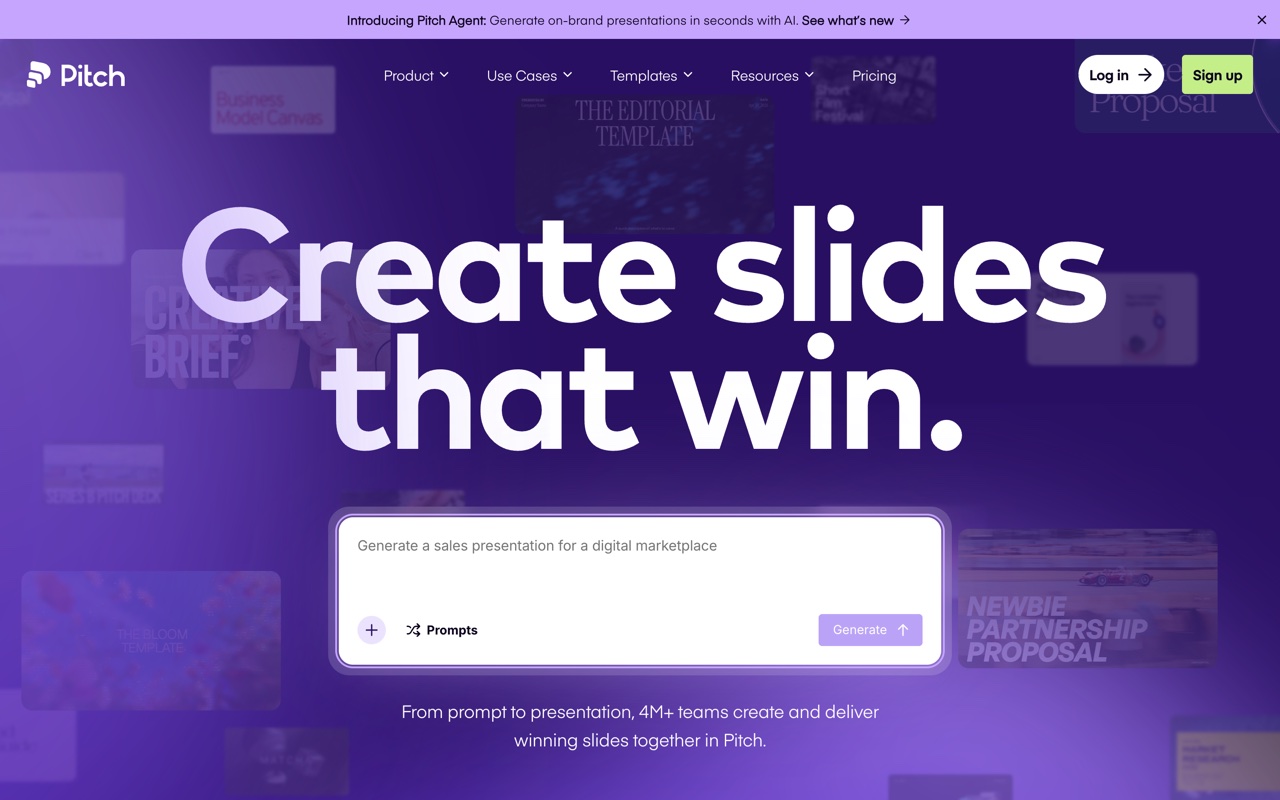 Pitch is built around real-time collaboration and a strong template gallery.
Pitch is for startup and sales teams who edit decks together, with comments, analytics, and sharp templates. Its AI agent drafts decks, but generation is not the headline. The free plan exports branded PDFs only; PowerPoint export starts on Plus, listed at €10 a month billed yearly.
#Canva
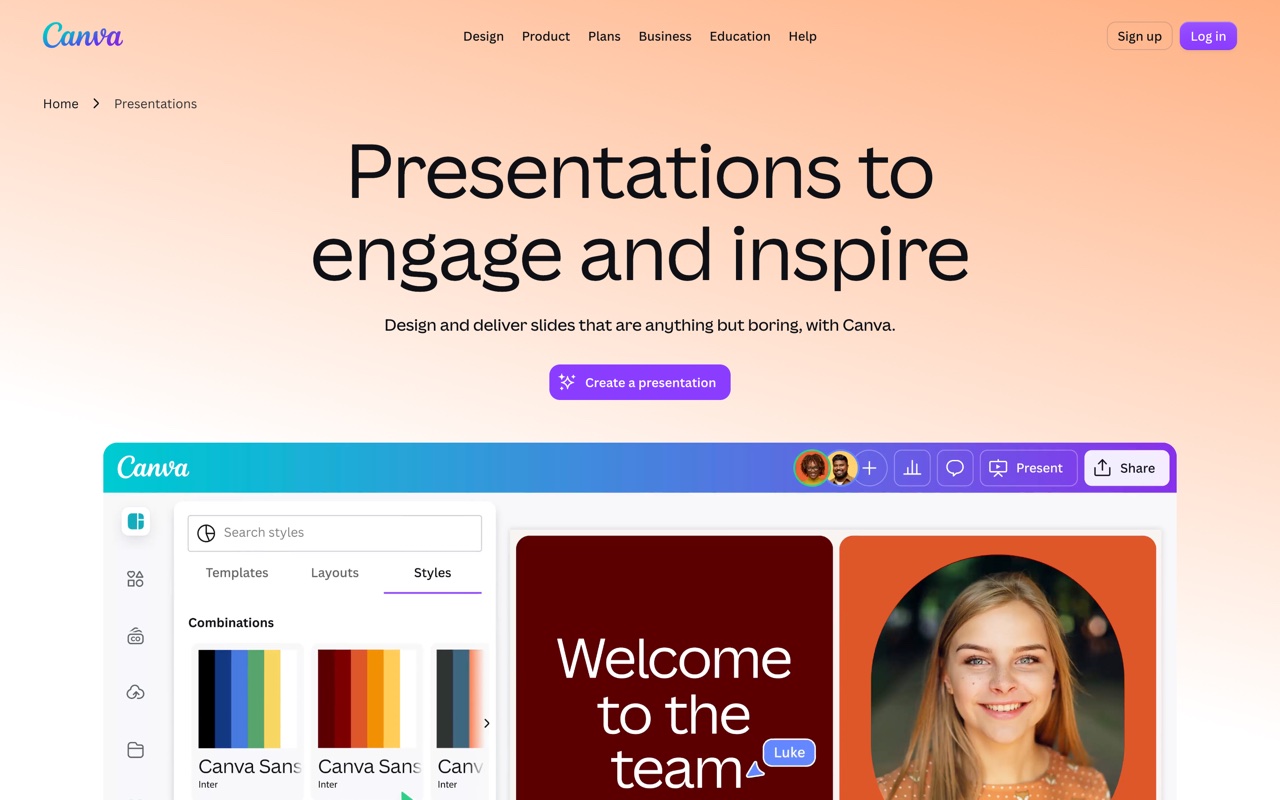 Canva folds AI decks into a much larger design suite.
Canva makes sense if your team already designs everything there. Magic Design drafts a deck from a prompt, the asset library is huge, and even the free plan downloads a .pptx. Presentations are one feature of a big design tool, so it can feel heavy if slides are all you make, and complex designs can flatten on export. The Canva alternative page covers the trade.
#Gemini in Google Slides
If your company runs on Google Workspace, Gemini now builds full, editable presentations inside Google Slides from one prompt, grounded in your Drive files. It needs Google AI Pro or Ultra, or Workspace Business Standard and above. You can download the result as a .pptx.
#If you want a quick guided draft
#Decktopus
 Decktopus asks questions and assembles a first draft from your answers.
Decktopus asks a few questions and builds a draft, with speaker notes, which is handy when the blank page is the problem. Pro is $9.99 a month billed annually. Design control is coarser than Gamma's, and reviewers report layout shifts when its decks are opened in PowerPoint.
Slidebean is still around for founder pitch decks. Tome, which used to top these lists, shut down its presentation product in 2025 to focus on sales software, so do not plan around it.
#If no one is in the editor: Gamma alternatives for agents and APIs
 heydecks returns a live deck, a PDF, and an editable PowerPoint from one API or MCP call.
heydecks is the AI slide creator for AI agents. POST /v1/generate returns a live deck URL, a PDF, and a PowerPoint file, and the MCP server at heydecks.com/mcp lets Claude, ChatGPT, Cursor, and other agents build decks, with the host model writing the copy. Every deck uses 95 fixed, hand-designed slide templates and is locked to your brand by the Brand Kernel, extracted once from your website. Because the source is slides rather than web cards, the PPTX (Solo and up) opens with live text boxes and native tables. Free includes 200 one-time credits (two decks) with watermarked PDF exports; Solo is $19 a month.
Where it fits: a SaaS product sending each customer a branded report deck, an agent whose task includes "make the deck," a nightly job turning CRM rows into account reviews. If a person is going to design one deck by hand, Gamma, Pitch, or Beautiful.ai will feel more natural. Here is a sales deck built from those templates, on a sample brand:

If software or an agent is the reason you are leaving Gamma, the heydecks vs Gamma comparison lays out where each one fits.
#Frequently asked questions
#What is the best free Gamma alternative?
Canva's free plan is the most capable, since it drafts decks with AI and downloads an editable .pptx. For AI inside PowerPoint at no cost, the ChatGPT for PowerPoint add-in has limited free usage. Most other tools offer trials rather than lasting free plans.
#What AI is similar to Gamma?
Presentations.ai, Decktopus, and Beautiful.ai work the same way: a prompt in, a designed deck in a web app out. Gamma's own design quality is still among the best of that group.
#Does Gamma have an API?
Yes. Gamma's generate API is available on Pro, Ultra, Team, and Business plans, and Gamma runs an MCP server for AI assistants. heydecks is built API-first, returning a live deck, a PDF, and an editable .pptx (on Solo and up) from one REST or MCP call.
#Which Gamma alternative exports the cleanest PowerPoint?
Tools that work inside PowerPoint (Copilot, Claude for PowerPoint, Plus AI) produce a native file because nothing is converted. Among generators, those built on fixed slides export more cleanly than those built on web pages.
Keep reading